UW Composites Analysis · Infusion Simulation
Resin Infusion Simulation: VARTM, RTM, Permeability and Gelation
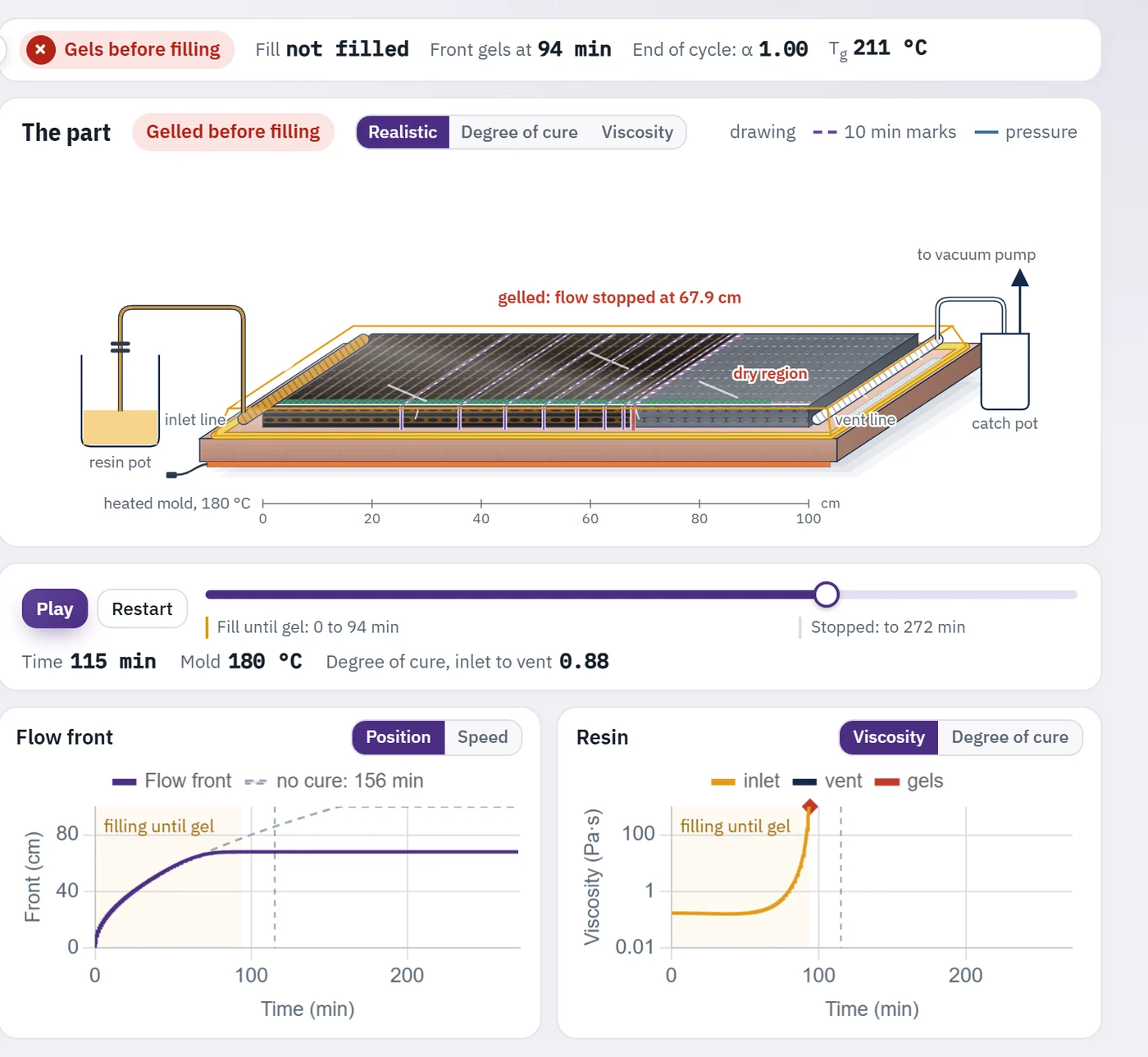
Fill a dry fiber preform with resin and watch the flow front move while the resin cures. The Infusion Simulation combines Darcy flow through the preform with the cure and viscosity of the resin, so you can see whether the part fills before the resin gels, or a dry region remains.
Open the Infusion Simulation →Free, runs in your browser, no installation or login.
What you can do
- Choose vacuum infusion (VARTM) or resin transfer molding (RTM) with injection pressure.
- Choose the preform (non-crimp fabric, woven fabric or random mat), fiber and fiber volume fraction.
- Set the flow length, the fill temperature and the cure that follows.
- Follow the flow front, the resin viscosity and degree of cure, and a close-up through the thickness at the flow front.
- Try one-click examples, such as a hot fill that gels before the part is full.
How it works
q = K ΔP / ∫ μ(x) dx, dxf/dt = q / φ, φ = 1 − Vf
Darcy flow from the inlet to the flow front xf, with the viscosity μ of each slice of resin as it cures.
tfill = φ μ L² / (2 K ΔP)
Fill time of a part of length L at constant viscosity.
K = C (1 − Vf)³ / Vf²
Kozeny–Carman permeability for the fabrics, fitted to published measurements.
CYCOM 890RTM cure, viscosity and gelation follow Khoun, Centea and Hubert (2010). Permeabilities are fitted to published measurements (Wu, Larsson and Blinzler 2021; Kessels 2006; Golestanian 2007). Every page of the app lists its full equations and sources under Equations.
Questions to explore
- A hotter fill makes the resin thinner. Why can it still leave a dry region?
- How much longer does a part take to fill when its length doubles?
- How does a higher fiber volume fraction change permeability and fill time?
Open the Infusion Simulation →