UW Composites Analysis · DSC Test
DSC Simulator: Heat Flow, Cure Kinetics, Degree of Cure and Tg
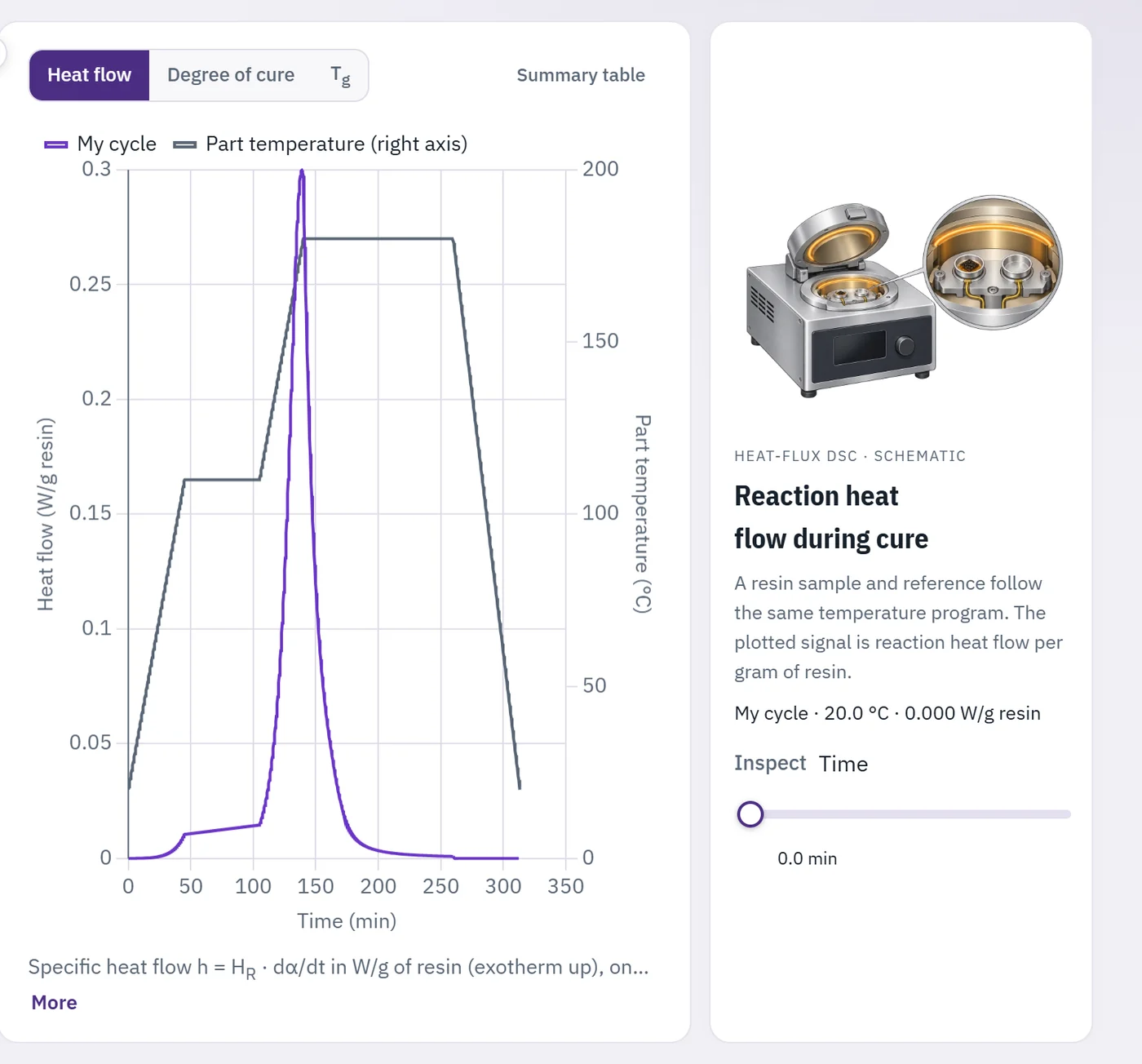
Simulate a differential scanning calorimetry (DSC) test on an epoxy resin. Set a temperature program and see the reaction heat flow, the degree of cure and the glass transition temperature as the resin cures, or analyze a dynamic scan to find the residual heat and the degree of cure of a part.
Open the DSC Test →Free, runs in your browser, no installation or login.
What you can do
- Run dynamic ramps, isothermal holds or any temperature program on Hexcel 8552 or CYCOM 890RTM.
- See the exotherm peak shift with heating rate, and the reaction slow down as the resin vitrifies.
- Follow degree of cure and glass transition temperature over time.
- Analyze test data: find the residual heat of reaction from a dynamic scan and the initial degree of cure.
- Use the same cure model in the Rheology Test and the Cure Simulation.
How it works
q = HR dα/dt
Heat flow per gram of resin; HR = 600 J/g for 8552 and 430 J/g for 890RTM.
Hres = ∫ (q − qbaseline) dt, α0 = 1 − Hres / (Wm HR)
Residual heat from a dynamic scan, and the initial degree of cure.
Tg = Tg0 + λα (Tg∞ − Tg0) / [1 − (1 − λ) α]
DiBenedetto relation between degree of cure and glass transition temperature.
Hexcel 8552 cure kinetics and Tg follow Van Ee and Poursartip (2009). CYCOM 890RTM follows Khoun, Centea and Hubert (2010). Every page of the app lists its full equations and sources under Equations.
Questions to explore
- Why does the exotherm peak move to higher temperature at faster heating rates?
- How can a dynamic scan tell how far a part has already cured?
- Why does the reaction slow down long before the resin is fully cured at a low hold temperature?